Introduction
Nowadays, Genetically Modified Organisms, or GMOs, are well known to us despite the fact of their first appearance only in the twentieth century. However, not many people would recall the first experiments and results related to food. Also, some of the genetically modified food can hardly be noticeable in spite of labelling in markets all over the world. Therefore, changes made to some food species may not be recognized by people, thus making them believe that the food they consume every day had other characteristics distinct from today’s ones.
In this article we will go into the history of some of the first GM fruits, how they were adjusted, how they gained approval to appear on the market, and what role they play in our time.
Vegetables
A tomato was the first in a row of GM plants which was commercialized. This significant event occurred in 1994 after a series of gene transferring and editing experiments provided by Calgene Inc. . Basically, the tomato’s taste had a drawback due to harvesting tomatoes before maturity, which was actuallynecessary due to efforts made for not losing the tomatoes during transportations. Therefore, Calgene Inc. decided to prolong the time after which the tomato softens in order to harvest it right at the ripe step. As a result, the tomato became more consistent, and its over-ripening rate decreased. Consequently, activity of fungi populations was postponed in the tomato. Besides, after several tests of experiment influencing the tomato’s other qualities, no changes were observed [1,2].
The next step of Calgene Inc. was to get an approval to their new product from the FDA (Food and Drug Administration). They were successful in commercializing their product and labeled it as Flavr Savr™ tomato in 1994. It also was welcomed in Mexico and Canada later. However, company encountered a problem of the tomato’s firmness and its distribution process. In the end, Flavr Savr™ tomato was removed from shelfs in 1997[1].

Figure 1. Non-GMO tomatoes (left) and GMO tomatoes (right)(1).
It is needed to mention that, not only this tomato event, but other ones were produced. During the same years other companies wanted to commercialize their own GM tomatoes using techlonology of Calgene Inc. Nevertheless, not all of them had a sustainable progress after reaching their goal, despite the newtraits of their tomatoes, such as virus and pest resistance (for instance, resistant to Tobacco mosaic virus, Cucumber mosaic virus; the tomato fruitworm, pinworm, hornworm, potato tuber moth, and cabbage looper) [1,2].
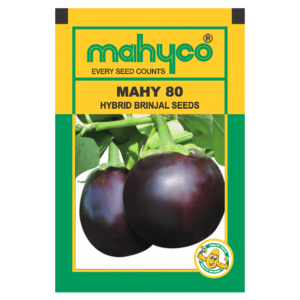
The first GM eggplant was designed by Maharastra Hybrid Seeds Company (Mahyco) working with Cornell University and Monsanto. Their aim was to make the eggplant resistant to the eggplant fruit and shoot borer [1,2].
A line of experimented eggplants was named as EE1 line. Bacillus thuringiensis’s HD73 strain’s CaMV 35S promoter andsoybean’s 7S alpha terminator were used in this process. In the end, modifications showed substantially good results – average rate of insect mortality became 99% [1,2].

Figure 2. GM eggplant from Maharastra Hybrid Seeds Company (Mahyco) (2).
In 2009, this eggplant line received an approval for cultivation in India; but then was closed due to negative public reactions.After six years, it was being commercialized in Bangladesh, and was likely to be cultivated in the Philippines [1].
Embrapa 5.1 event was constructed by Brazilian AgriculturalResearch Corporation in order to receive common bean’s resistance to Bean golden mosaic virus. Technology included post-transcriptional silencing of virus’s replication gene and usage of the gene from Arabidopsis thaliana. Modified plant showed successful results of 93% of the plants symptomless, whilst 100% of non-GM ones were found to have expected symptoms [1,2].

Figure 3. GM common bean (3).
In 2011 the National Technical Biosafety Commission claimed Embrapa 5.1 as safe for culture and consumption. In 2015 this line was known as BRS FC401RMD after registration provided by the Brazilian Ministry of Agriculture, Livestock and Food Supply [1].
Fruits
Canadian Okanagan Specialty Fruits Inc. became a founder of three GM apple varieties: ‘Arctic® Golden’, ‘Arctic® Granny’, and ‘Arctic® Fuji’. The main characteristic of their apples is theabsence of browning after being cut or sliced. It is attributed to an inhibition of enzymes playing a role in an oxidation process.Again, RNA interference and transcription silencing were the main methods used in the experiments [1,2].

Figure 4. Non-GM apple (left) and GM apple (right) (4).
‘Arctic® Golden’, ‘Arctic® Granny’, and ‘Arctic® Fuji’ were controlled and approved by three organizations – Health Canada in 2011, Canadian Food Inspection Agency, and the USDA’s APHIS in 2015. In 2017, company collected the first harvest and ‘Arctic® Golden’ apples appeared on the shops’ shelves. Besides, the company is planning to produce a new line,‘Arctic® Gala’, in the future [1].
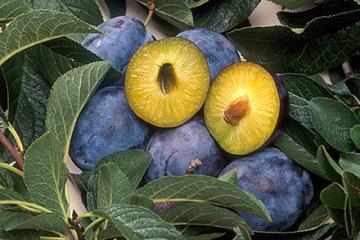
Today, known as ‘HoneySweet’ or C5 event was developed bythe USDA-ARS Appalachian Fruit Research Station. It has the resistance to the Plum pox virus (PPV) [1].
The post-transcriptional gene silencing of PPV technology was applied to selection of the plum, thus stopping an expression of a coat protein of PPV. Field tests of ‘HoneySweet’, provided in Poland, Romania, the Czech Republic, and Spain, have proved the success derived from experiments. Later, GM plum trees additionally showed the resistance to Prune dwarf virus and the Apple chlorotic leaf spot virus in the Czech Republic [1,2].

Figure 5. GM plum (5).
‘HoneySweet’ gained approval of the FDA in 2009, and a status of PIPO (Plant Incorpotated Protectant), which allowed it to be cultivated and sold in the USA. Only this one GM plum from others is officially approved and used as the food [1].
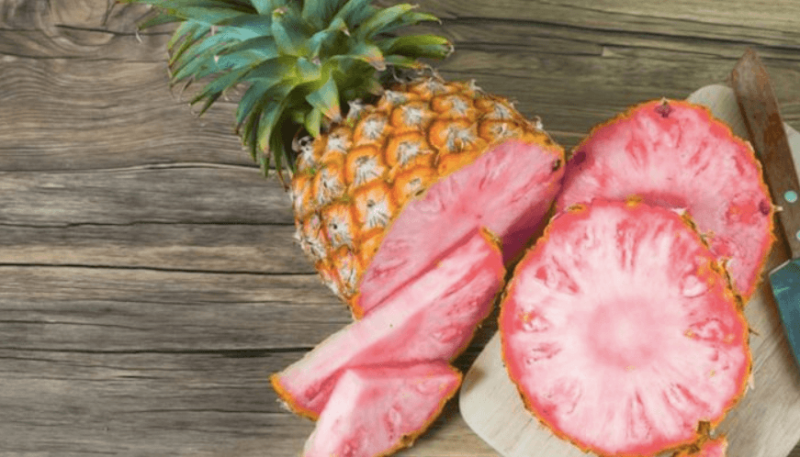
Another development was programmed for changing the taste and color of pineapple. US Del Monte Fresh Produce Company produced the ‘Extra sweet pink flesh pineapple’, or MD2 [1].
Materials used: mutant gene from tobacco, tangerine genes, the pineapple meristem gene, and additional cyclases. The approach was the same as for some fruits and vegetables above – the RNA interference and post-transcriptional gene silencing [1].

Figure 6. GM pineapple (6).
As a result, modifications resulted in red or pink flesh, which had an attraction impact for consumers [1,2]. These pineappleswere grown in 2008. In order to cultivate GM pineapple in Costa Rica, the company received a permit from the NationalTechnical Commission on Biosafety of the Ministry of Livestock and Agriculture in 2011. Nowadays, the ‘Extra sweet pink flesh pineapple’ is the only GM approved pineapple andpresents 90% of whole world export [1].
Role of greengroceries’ genetic modification
As shown above, we can consider the main reasons why greengroceries are genetically modified today, and why it is necessary.
First, we have a population burst in many countries affecting the Earth’s total population rate. In other words, more people – more demands. However, time that is required for plants to grow, flower, and give own edible parts, cannot decrease in one moment. Also, in order to rush the yield outcomes, farmers buy lots of farmlands for cultivation, thus taking excessive placeswhich could be used in other fields, like urban infrastructure [3].
Secondly, the changing climate is a huge problem for us, as it influences harmfully on conditions in which the greengroceries grow. This dependance on such auspicious conditions costs a lot for the companies, leading to water, soil, and seed waste.Consequently, such modifications aimed at reducing flowering time and fruit ripening time can be interpreted as a last resort for the farmers. That is, the companies gain the yield early enough, additionally, not following special conditions anymore because they are not required from this moment. These changes have no water waste and permanent daylight within. Also, by prolonging the fruit ripening time, a shelf-life extension, reduced waste of over-riped greengroceries, reduced purchases, and money wasteof shops and retailers are reached [2,3].
Thirdly, all organisms are exposed to different diseases, and the plants are not an exception. Virus, pathogen, and pest resistanceof the eggplant and plum, written above, proves that the genetic modifications help the plants to withstand the diseases and death, and, therefore, help the farmers not to lose excessive amount of the plants [2,3].
The fourth reason embodies the consumers’ expectations of how the fruits and vegetables they eat should taste or look like. Enhanced quality traits, like exampled above, non–browning of the apples, increased sweetness and attractive appearance of thepineapples, and consistency of the tomatoes, give points to marketability of such greengroceries [1,2].
Conclusion
Overall, we can infer the enormous role that first genetically modified greengroceries played in satisfaction with the people’s demands and market requirements. They made a huge push to economics of the companies and farmlands together with biotechnology, genetics, and GMO fields. Today and tomorrow’s developments, in prospective, may lead to the usage of less or none of toxic pesticides and herbicides on the plants, changing this focus on themselves in terms of protecting harvests. Also, it is important to note that some genetic modifications can indirectly influence carbon dioxide emissionsdecrease, thus making the efforts in keeping the environmentclear from contamination [3].
References
1) Baranski, R., Klimek-Chodacka, M., & Lukasiewicz, A. (2019). Approved genetically modified (GM) horticultural plants: A 25-year perspective. In Folia Horticulturae (Vol. 31, Issue 1, pp. 3–49). Sciendo. https://doi.org/10.2478/fhort-2019-0001
2) Lobato-Gómez, M., Hewitt, S., Capell, T., Christou, P., Dhingra, A., & Girón-Calva, P. S. (2021). Transgenic and genome-edited fruits: background, constraints, benefits, and commercial opportunities. In Horticulture Research (Vol. 8, Issue 1). Springer Nature. https://doi.org/10.1038/s41438-021-00601-3
3) Biswas, S., Srivastava, A., Yadav, S., & Mishra, Y. (2020). Evolution of Genetically Modified (GM) Crops and The Scared World. In Policy Issues in Genetically Modified Crops: A Global Perspective (pp. 317–334). Elsevier. https://doi.org/10.1016/B978-0-12-820780-2.00014-5
Figures